
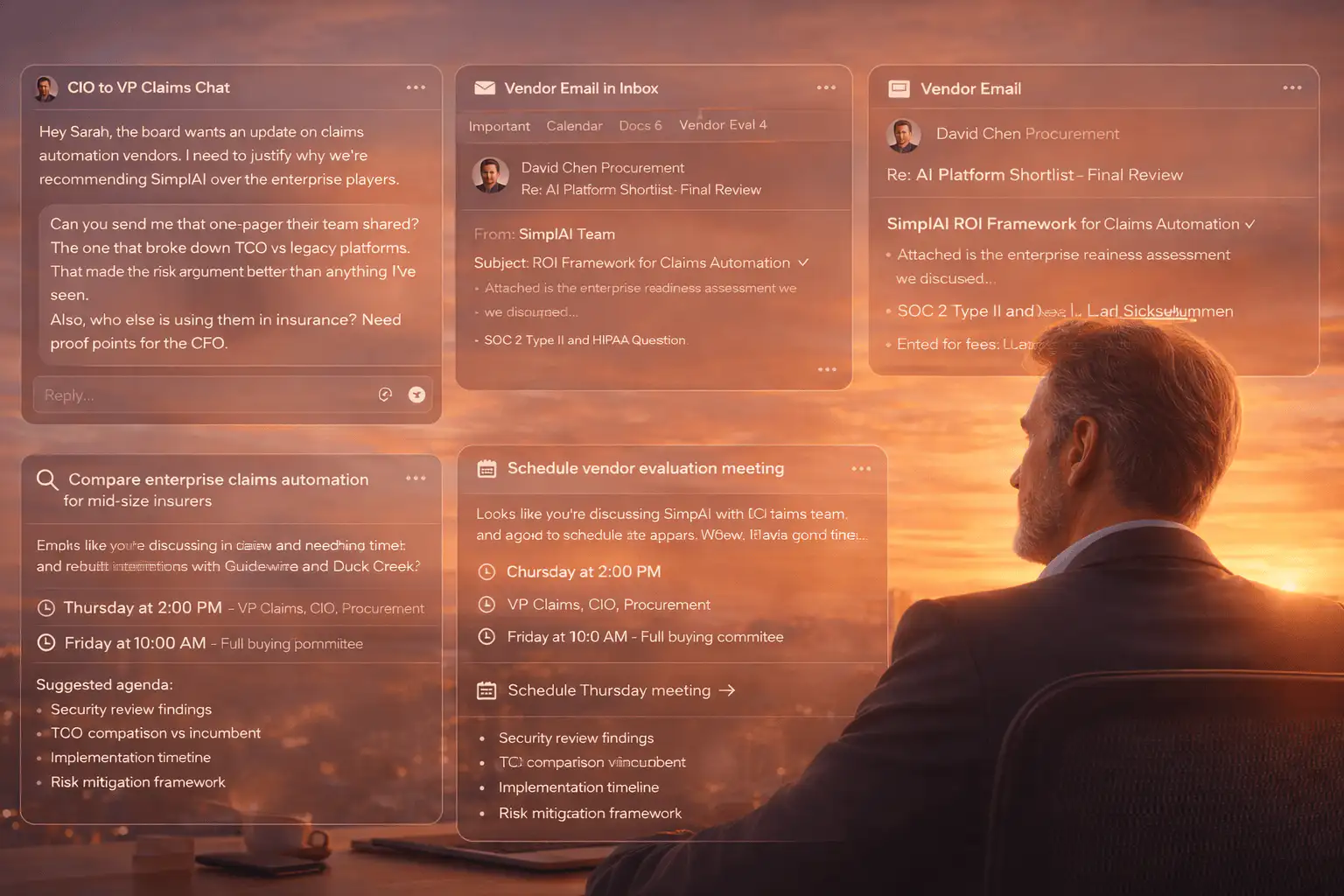
We have refined ICPs, mapped buying committees, built account intelligence, and coached sales motions at enterprise AI companies selling into Fortune 500 accounts. We have seen what makes the motion work. And we have seen what keeps it broken. Here is why we do things differently.
Most enterprise GTM services optimize for meeting count. We optimize for whether the meetings actually move pipeline.
Booked meetings feel good. But when your AE walks into a Fortune 500 conversation and the CDO already understands her own roadmap reflected back, that is what builds the deal. When the buying committee forwards your Signal internally to the CISO, the CFO, and procurement, that is what compounds. When your CRO can show the board a target list of named accounts with substantive senior conversations in flight, that is what defends the next round.
We do not count meetings. We count whether your motion is producing the conversations that actually close.
Your enterprise motion exists alongside product roadmaps, board commitments, sales cycles, and the CRO's quarterly plan. We see the bigger picture: how account intelligence fits with demand gen, ABM campaigns, partner motions, executive briefings, and the multi-quarter buying journeys your team is running.
We also get the internal dynamics. Getting buy-in from your CEO, your CRO, your CMO, and your CFO on a new layer in the GTM stack is not easy. We help you communicate impact in language that resonates with each stakeholder — pipeline coverage math for the CRO, brand integrity for the CMO, unit economics for the CFO, board-defensible narrative for the CEO.
Open the inbox of any senior buyer at a Fortune 500 right now. Scroll for 30 seconds.
Templated sequences from companies you have never heard of. AI-personalized hooks that read as AI-personalized in four seconds. Generic ABM impressions chasing badge swipes. SDR cadences built for SMB applied to a 12-person buying committee. Volume into the wrong inboxes by the hundred.
That is the noise. We produce the signal.
Every Signal we ship starts from real public-source intelligence on the named account. A CEO earnings commitment. A board-level priority shift. A CISO compliance posture. A CFO budget allocation. A recent hire and what it signals. An RFI window opening. A regulatory disclosure naming the unfinished layer in their stack. That is what earns the substantive first conversation. That is what gets forwarded internally inside the buying committee. That is what builds the deal over a multi-quarter cycle.
Most Series A to C companies arrive at the conversation with one of two problems on their ICP and target list.
Their list is too long — every Fortune 1000 logo. Which means none of them are real targets. The BDRs are running thin coverage across hundreds of accounts and producing nothing substantive at any of them.
Or their list is too short — the three accounts the founder already knows. Which is not an ICP. It is a Rolodex.
We fix this in the first week of every engagement. A senior enterprise GTM operator who has closed real Fortune 500 deals works with you to refine the ICP by vertical, by trigger event, by procurement profile, by deal shape, by stack signal, by close cycle length. Then we pick the 20 to 60 named accounts that should be the engagement's focus. The accounts where your team can actually win this quarter. Not the wishlist. The winnable list.
Procurement has a process. Vendor Management Office gates every new partner. The buying committee has 12 named humans across business, technology, risk, finance, security, and legal. Annual budgets are allocated to specific category lines. Compliance reviews run in parallel with technical evaluation. MSAs have negotiated terms the buyer expects you to accept.
Most companies selling into the enterprise ignore this machinery. They run motions built for SMB conversion and wonder why the enterprise deal stalls at procurement, dies in security review, or never makes it past the VMO.
We do not ignore it. Every Signal we ship is shaped to how the buying committee actually evaluates. Buyer center mapped to the 12 named humans. Existing investments respected, never displaced. Compliance posture surfaced. Procurement window identified. Budget allocation traced. Champion named. That is why the deals we help open actually close.
Most enterprise GTM services do not even know what a Vendor Management Office gate looks like. We build every Signal around it.
We do not ship 30 Signals and disappear. We embed in your operating cadence.
Every week, we sync with your sales leadership to understand what is happening inside the named accounts. What is landing. What is not. Which buyer is responsive. Which buying committee just shifted. Which trigger event just opened a window. We adjust the playbook around it. Your enterprise motion is not a separate operation. It is wired into your existing sales rhythm.
When the engagement ends at Day 90, we do not fight to stay. We hand over everything. The ICP refinement work. The 20 to 60 Signal artifacts. The buyer center maps. The champion identifications. The sequence templates. The stack coaching playbook. Your team owns the motion. If you need a second wave six months later when a new vertical opens or a CRO transition resets the target list, we are here. If you do not, the intelligence layer is a capability your company keeps.
Every month, you get a performance read with real numbers. Named accounts engaged. Signals opened. Buying committee members reached. Senior conversations booked. Pipeline contribution attributed. What is working and what is not. What we are adjusting next month based on what we have learned.
If a Signal is not landing, we tell you. If the ICP refinement needs another pass, we say so. If a specific named account is structurally unwinnable and should be replaced on the target list, we make the call. We do not hide behind vanity metrics or stretch the engagement past its useful end.
We ask for 90 days because enterprise GTM compounds across multi-quarter cycles. Inside those 90 days, you see substantive first conversations on calendars, buying committee members engaging with Signals, and named accounts moving from cold to pipeline. If you do not, that is on us.
We do not optimize for booked meeting count. We optimize for substantive senior conversations at named winnable accounts. If you need 200 meetings a quarter regardless of quality, hire a volume agency. The math will be worse but the meeting count will be higher.
Enterprise GTM compounds across multi-quarter cycles. ICP refinement, account intelligence, buyer center mapping, and senior coaching cannot be compressed below 90 days. If you need pipeline results in 30 days, this is not the right shape of work. Not because the work is slow. Because enterprise buying does not move that fast.
Our process works because senior judgment is in the room and senior judgment ships. You get the Signal artifacts on a defined cadence. You review on a defined cadence. If you need line-by-line edits on every sequence draft and every buyer center map, the cadence breaks and the senior time gets consumed by edit cycles instead of judgment.
We refine the ICP, build the intelligence, draft the sequences, identify the champions, and coach the team. We do not staff your CRM. We do not send your outreach. We do not take your first calls. If you do not yet have a BDR, an AE, or a founder running revenue, you are pre-engagement. Build the team. Then come back.
If your company is still debating whether to chase enterprise or stay focused on mid-market and SMB, this is not the time. Account intelligence is expensive at the unit level and only justifies itself when the deals are enterprise-sized. If you are not yet sure, run the SMB motion for another two quarters, then come back when enterprise is the explicit focus.
Some companies want strategy, brand, content, paid, events, partnerships, and sales all under one contract. That is possible to find, rarely well, and definitely not us.
We have an intense focus on what we do exceptionally well: account intelligence and senior coaching for enterprise AI companies selling into Fortune 500 buying committees. We write for the procurement-aware enterprise buyer. We create the substantive first-conversation ammunition your sales team uses. We do not produce brand decks, paid ad campaigns, or marketing collateral.
If you want full GTM strategy redesign — the kind of work that restructures the entire revenue function and resets the multi-year plan — that is a separate conversation. Book Joseph directly for that.

You have named enterprise accounts on your target list right now that should have been closed by Q2. Buyers who took the first meeting and went quiet. Buying committees that stretched the cycle from two quarters into four. Senior decision-makers who said they needed "more information" but never said which information.
The problem is not your product. The problem is that the motion you are running does not match how those enterprises actually buy.
We close that gap. One account at a time.
Let's talk →

.svg)


