
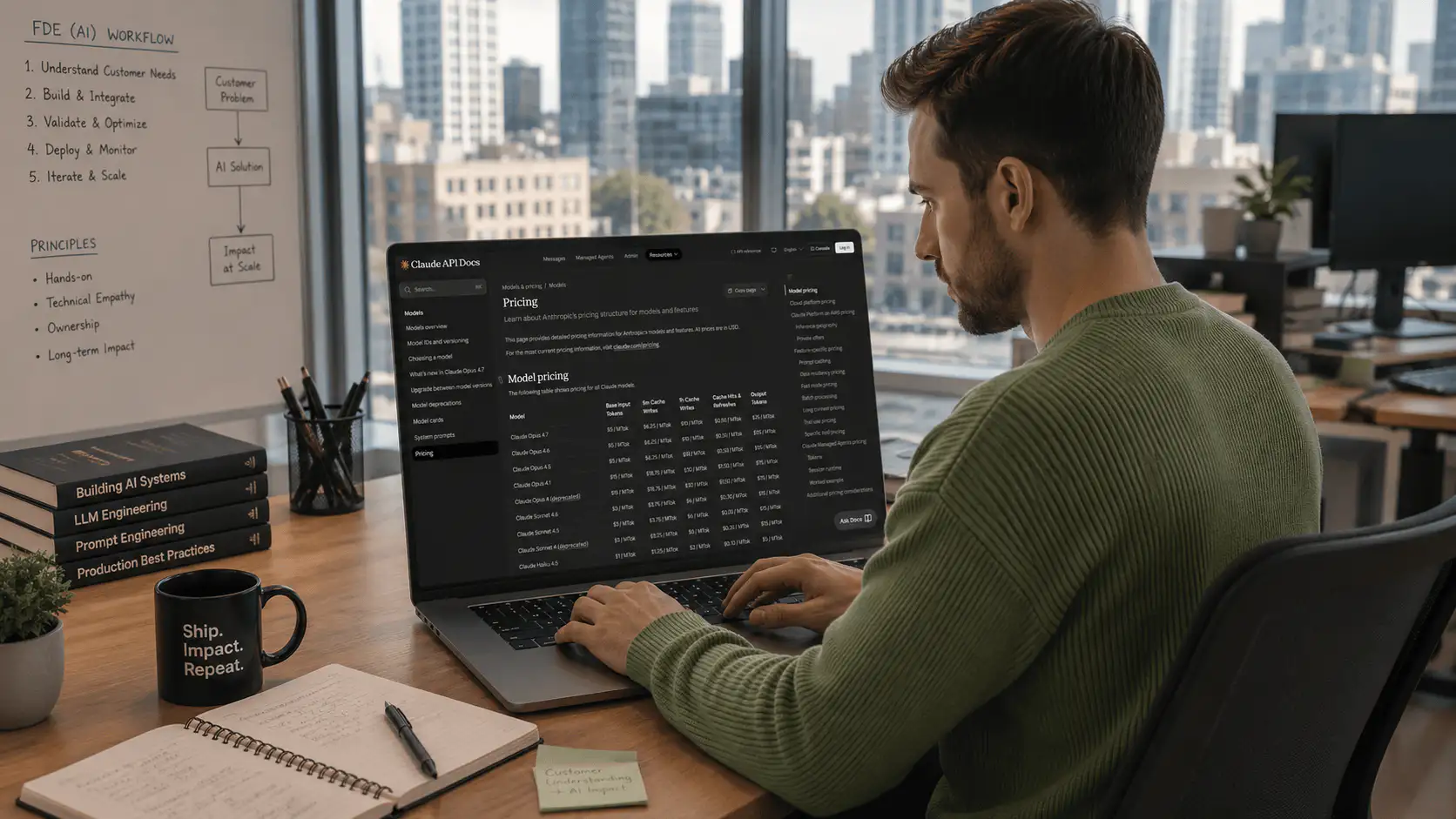
I was looking at Anthropic's API pricing documentation the other week for an unrelated reason, and something caught my eye.

The current flagship model, Claude Opus 4.7, is listed at $5 per million input tokens and $25 per million output tokens. Sonnet 4.6, the mid-tier model, sits at $3 input and $15 output. Haiku 4.5 is $1 and $5. Standard pricing for a modern API, in line with what other frontier labs are charging for equivalent capability tiers.
The line that caught my eye is two rows down. Claude Opus 4.1, marked deprecated in parentheses next to the model name, is priced at $15 per million input tokens and $75 per million output tokens. Opus 4, also deprecated, costs the same. The deprecated flagship models are not slightly more expensive than the current flagship. They are exactly three times more expensive.
On the same pricing page. For models the company itself has labeled with the word "deprecated."
The first thing I thought about, looking at this, was the migration campaign that did not happen.
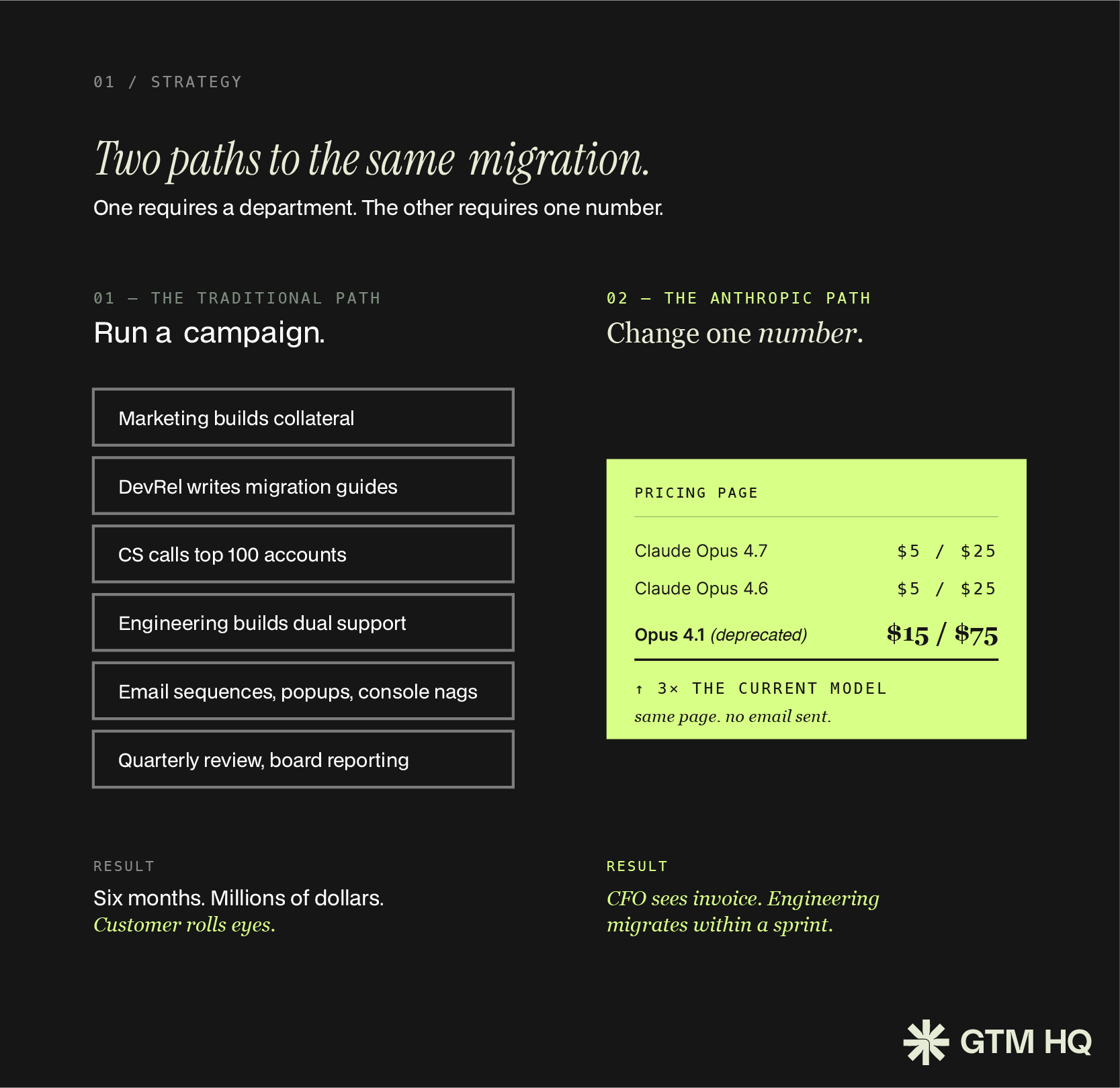
If a typical enterprise software company had wanted to migrate developers from Opus 4.1 to Opus 4.7, they would have built one. Marketing would have produced collateral. Developer relations would have published migration guides. Customer success would have called the top accounts. Engineering would have committed to dual-version support for twelve to eighteen months. There would have been emails, console popups, blog posts, a launch event, possibly a microsite. Months of work, millions of dollars, and a wall of human attention pushed against an audience that did not ask for it.
I do not see any evidence Anthropic did any of this. What they did instead was list the deprecated model at 3x the price and leave it there.
I have been thinking about why this is the more elegant move, and what it suggests about how the smartest software companies are going to be run for the next decade.
Why the move works
The mechanism is structural and worth slowing down on.
When a software company deprecates a product version, it inherits a problem. The old version is in production at customer sites. Customers have written code against it, tested it, gotten approvals through their security teams, integrated it into pipelines that the platform team does not want to touch. Inertia is the customer's default state, and the customer's inertia is the vendor's liability — every legacy version in production is a maintenance cost, a support burden, a compatibility constraint on future releases, and a security surface the vendor has to keep patching.
The conventional response is a migration campaign. This works, sort of. It also depends entirely on the willingness of individual developers at customer companies to prioritize a migration that they did not ask for and that does not improve any metric they are personally measured on. Most developers, when asked nicely to migrate, file the email under "later." Later rarely arrives.
What Anthropic did was different. By pricing the deprecated model at three times the cost of the current model, they converted the migration decision from a relationship question into a budget question.
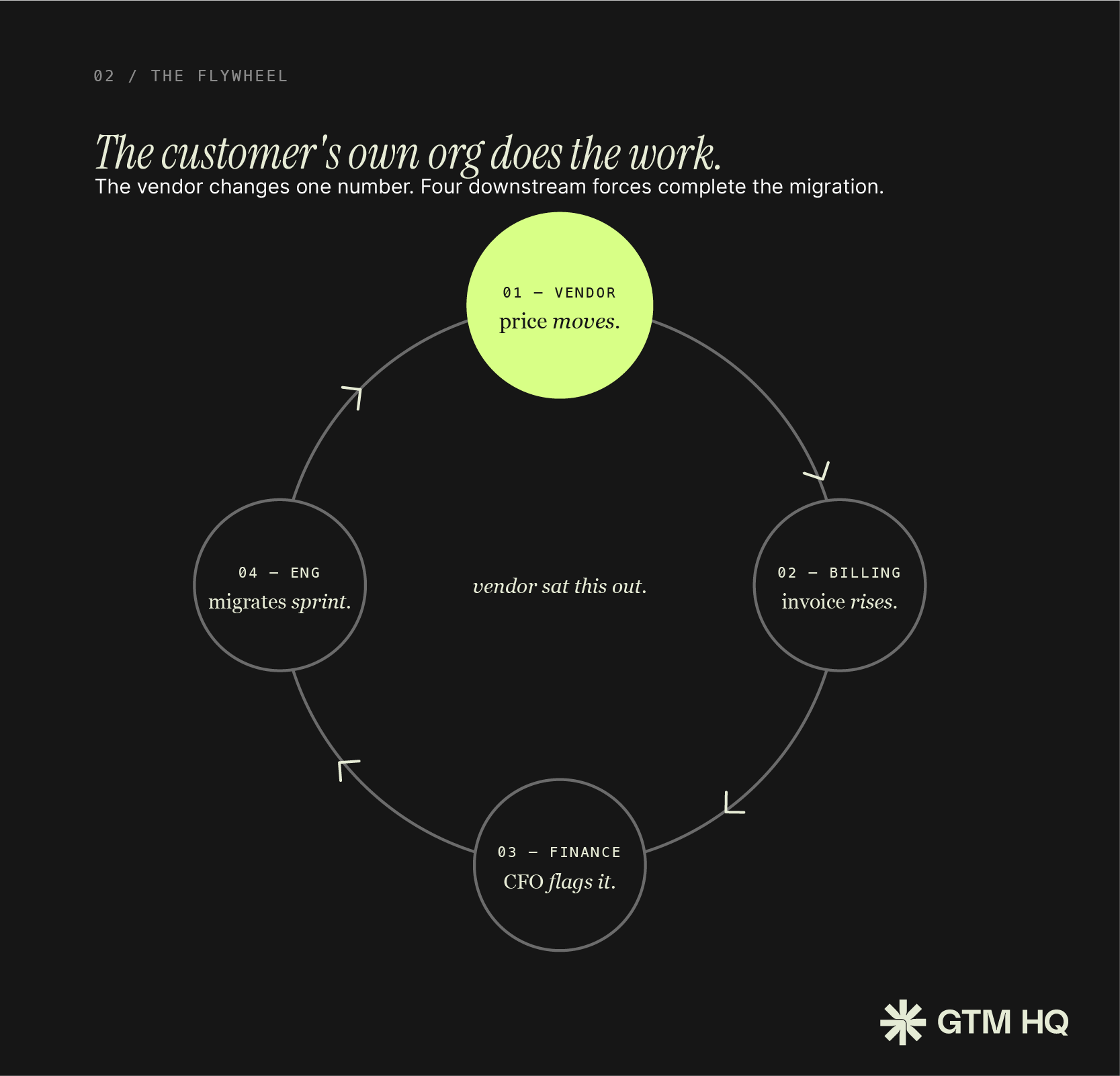
A developer who keeps their pipeline on Opus 4.1 is not being asked to read a migration guide. They are being shown a number on next month's invoice. The number is three times what it would be if they migrated to Opus 4.7 or 4.6. That number gets surfaced by their finance team. The finance team asks the engineering team why the same workload is costing three times what comparable workloads at other companies are costing. The engineering team migrates within a sprint.
The vendor did not have to send a single email. The customer's own internal cost pressure did the work.
What I find interesting about this is the asymmetry of attention. A migration email reaches the customer's developer's spam folder in one minute and competes against every other email they receive that day. A 3x line item on next month's invoice reaches the customer's CFO and competes against the CFO's actual job, which is finding cost overruns. The structural authority of a finance flag is higher than the structural authority of a vendor email. The cycle time on a price signal is faster than the cycle time on a marketing campaign. And the price signal travels through systems the customer's organization already takes seriously — billing, FP&A, cost-optimization reviews — rather than through the systems the customer is actively trying to ignore.
There is also something worth noticing about the respect this implies for the customer's autonomy. Anthropic is not nagging anyone. They are publishing a price and trusting the customer to make a rational decision. The simplicity is the strategy.
The pattern, when you look for it
Once you notice the move, you start seeing it in other places.
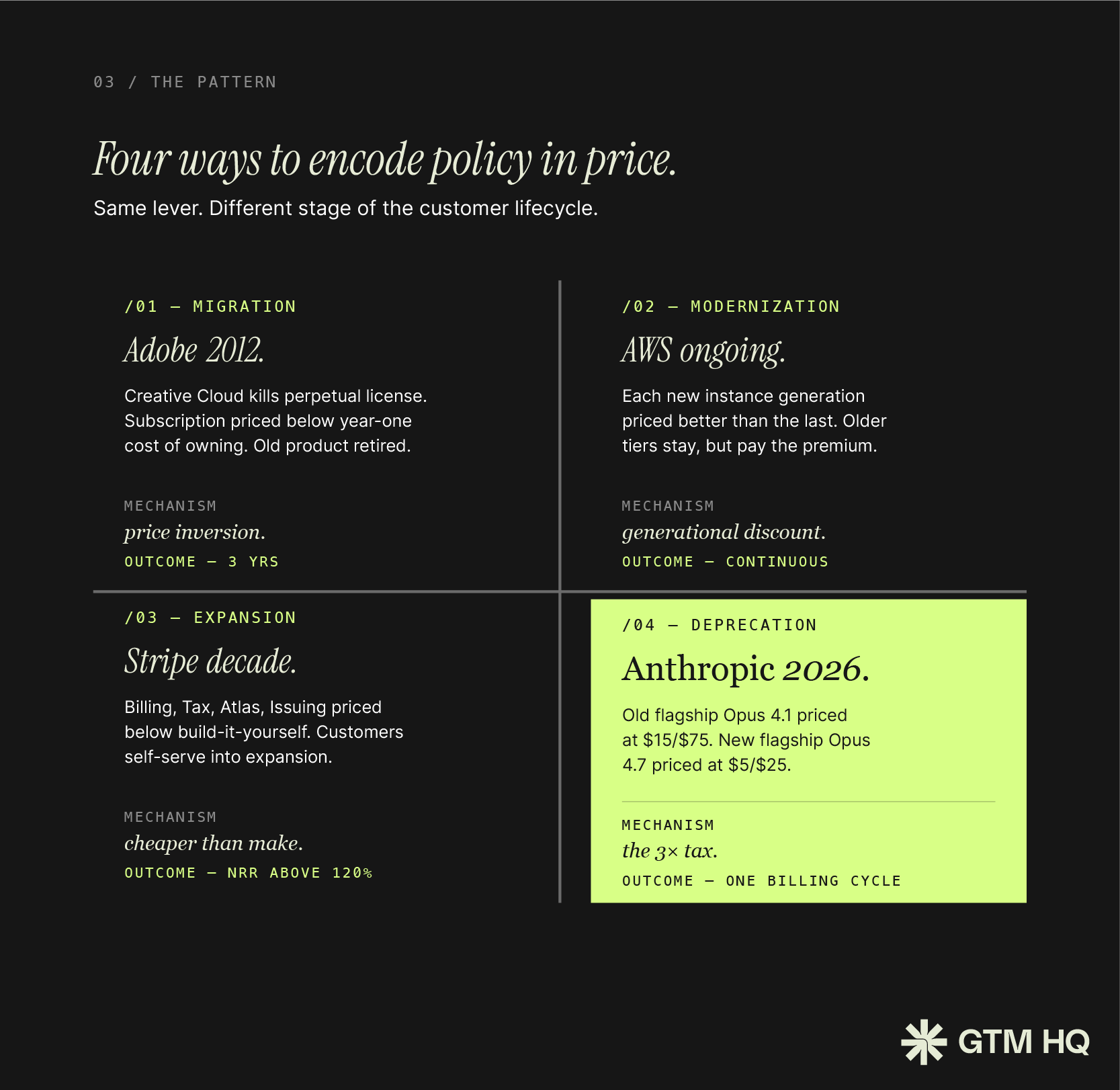
Adobe Creative Cloud, 2013. Adobe announced at its MAX conference in May 2013 that Creative Suite 6 would be the last perpetual-license version of its creative software. All future versions would be available exclusively through Creative Cloud subscription. The creative community was loud about its displeasure. A change.org petition gathered tens of thousands of signatures. Adobe accepted the noise and held the line on the pricing decision. The perpetual product was fully discontinued by 2017. Adobe did not run a migration campaign in the traditional sense; they made the new product the only product available, and let customers choose between the new pricing and no Adobe at all.
What I notice about this case in retrospect: the financial vindication took longer than people remember. Adobe's stock dipped, GAAP revenue declined during the transition, and the company endured what its CFO Mark Garrett later called a deliberate revenue gap. By 2015, recurring revenue had overtaken legacy perpetual revenue. By FY2025, Adobe reported $23.77 billion in revenue with 96% from subscriptions, versus $4.4 billion in the last full perpetual-license year. The pricing decision was the policy. The customers migrated because the company refused to keep selling them the old product, not because anyone sent them a guide.
AWS instance generations, ongoing. AWS does not call any of its services deprecated. It does not have to. The pricing structure of newer instance types is consistently better than the older equivalents. A customer running an m3 instance in 2018 was paying meaningfully more per unit of compute than a customer running on an m5, and meaningfully more again than a customer on m7g using Graviton processors. AWS did not send migration emails. They published the pricing, and the customer's CFO escalated through the engineering team about why the bill was not coming down. The same dynamic plays out across most of the AWS catalog — newer database engines versus older ones, serverless versus EC2, Graviton versus x86. AWS encodes its product strategy in its price book and lets customers translate the price book into engineering roadmap items on their own time.
Stripe expansion, ongoing. When Stripe launches a new product — Billing, Tax, Atlas, Issuing — the pricing is set at a level where adoption tends to be the rational choice for customers who already use the core payments product. Stripe does not have to mount a sales campaign to convince existing customers to expand. Customers find the new product through normal usage, evaluate the price against the cost of building it themselves or going to a separate vendor, and self-serve their way into the expansion. Stripe is private, so there are no public retention numbers to cite, but the pattern is observable in how their products compound usage among existing customers.
In each of these cases, the company replaced human-led campaigns with price-led policy. The customer's own organizational dynamics did the work the vendor's GTM team would otherwise have done.
The Anthropic move is the latest example. It is also the cleanest, because the move is just one number on one pricing page, and the structural logic is visible to anyone who scrolls down to the deprecated-model row.
What I think this means
The pattern I notice across these examples points to a particular way of thinking about pricing that most enterprise software companies do not operate from.
Most software companies treat pricing as an output. The product team builds features, the finance team calculates costs, the GTM team picks a number that covers cost plus margin, and the pricing page reflects what the company has decided to charge. Pricing in this model is a passive surface. It describes the company's intent. It does not enforce it.
The companies in the examples above seem to treat pricing as an input. The pricing page becomes the policy lever. It is where the company encodes the behavior it wants from its customers, and the customer's response to the price becomes the mechanism by which the policy gets executed. The pricing page is doing the work the GTM team thinks it is doing.
The implication, if this is right, is that the most powerful GTM moves are pricing moves, and the most powerful pricing moves are GTM moves. Most enterprise software companies separate these functions organizationally — pricing decisions live with finance and product, GTM decisions live with marketing and sales — and the separation tends to produce pricing pages that are passive and GTM campaigns that work against the price structure rather than with it.
There is also a precondition worth naming. The Anthropic move works because Claude Opus 4.7 is genuinely better, faster, and cheaper than Opus 4.1 on most workloads. Adobe could move customers to Creative Cloud because the bundle was a defensible value proposition. AWS can encode modernization in pricing because m7g actually is better than m3. Stripe can price its new products for self-serve adoption because the new products solve real problems. The pricing-as-policy move is a tool of confident product companies, not desperate ones. If a company tried this with a deprecated product that customers do not want to leave because the new product is worse, the 3x markup would read as extraction rather than as guidance, and the brand damage would be severe. The customers in these cases are not being trapped. They are being given a clear signal that the old thing is being retired, and they are being trusted to act on it.
What I am watching for next
A few patterns I am watching in 2026 that suggest this kind of move is going to get more common.
The first is that AI products are deprecating and being replaced on a six-month cycle. The old enterprise software playbook — eighteen-month migration windows, careful sunset periods, patient relationship management — is calibrated for a world where products lasted five to ten years. That world is gone. The companies that win the next decade will be the ones that can execute fast product transitions without breaking customer relationships, and pricing-as-policy is the cleanest tool for doing this.
The second is that enterprise customers are getting structurally better at reading pricing. CFOs are running cost-optimization reviews more aggressively. FinOps as a discipline is professionalizing. The internal authority of the finance function relative to the engineering function inside enterprise customers has been steadily increasing for about a decade. A clean price signal lands harder in 2026 than it would have in 2016.
The third is that the volume of vendor outreach in enterprise software has reached a point of self-defeating saturation. The marginal vendor email or LinkedIn message reaches a buyer's inbox that is already 90% noise. The cost of breaking through with a relationship-based GTM motion has gone up. The cost of breaking through with a price signal has not.
If those three things are right, the move Anthropic is making on its pricing page in 2026 is going to look, retrospectively, like the early signal of a broader shift in how enterprise software gets sold. The way Adobe's 2013 move ended up looking like the early signal of the SaaS transition, or the way AWS's early reserved-instance pricing in 2014 ended up looking like the early signal of the cloud cost-optimization industry.
I do not know that the pattern will hold. I am just noticing what I see.
The deprecated models are still on Anthropic's pricing page. The price is three times higher. The customers are migrating. Nobody had to send an email.


Joseph Abraham (Joe) is the co-founder of GTM HQ and the Global AI Forum. A former CXO turned trusted advisor to CXOs, he helps Series A–C AI and B2B software companies build predictable pipelines of Fortune 500 enterprise opportunities. He is the author of The Enterprise GTM Playbook, the most exhaustive published taxonomy of enterprise GTM motions for the AI era, and the architect of the NER, ERR, and NERE measurement framework.

.webp)


.svg)


